
Between 2018 and 2021, I designed and delivered training for Bass Pro Shops’s Tracker Boats division, the boat-manufacturing arm of the Bass Pro retail and marine empire based in Springfield, Missouri. The work combined two delivery models: LearnDash-based course development and live instructor-led training for teams who needed practical, role-specific learning.
The SCORM constraint
Tracker Boats’ organization ran an enterprise LMS built around SCORM delivery standards. That meant every training asset I built for LearnDash, the authoring and iteration environment, also had to be packaged as a SCORM-compatible export that the internal LMS could receive, track, and report on. The two environments had different structural assumptions: LearnDash is built around course/lesson/topic hierarchy and stores completion in WordPress; a SCORM LMS tracks completion in an xAPI or SCORM 1.2 data model and expects content packaged as a self-contained zip with a manifest.
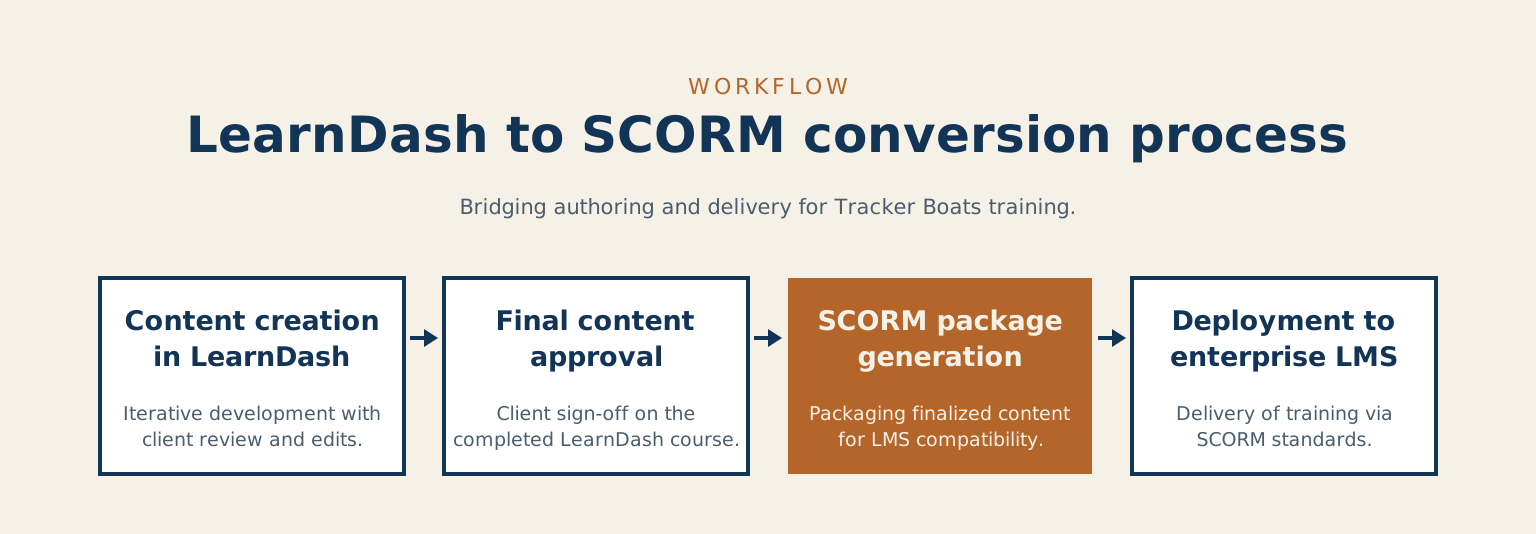
The workflow that solved this was building content in LearnDash for the iterative authoring pass (where the client can review, request edits, and approve) and then generating SCORM packages from the finalized content for deployment into the enterprise system. Neither the client nor the learner saw the double-layer; the authoring environment and the delivery environment each worked as they were designed to. The bridge was in the production process.
Instructor-led delivery
The ILT component covered the practical, role-specific knowledge that online modules can’t fully address: how to read a dealer’s floor plan against boat-model specifications, how to frame a Tracker product’s value proposition against the competitive landscape, how to handle a customer who has done extensive pre-purchase research online and arrives with specific technical questions. These are conversations, not click-through modules, and they require practice and feedback in a way that a SCORM package cannot deliver.
The online and instructor-led components were designed to work together: the online modules handled the declarative knowledge (model specs, features, compliance requirements, safety standards), and the instructor-led sessions handled the applied performance (conversation practice, objection handling, scenario walkthroughs). Learners arrived at ILT sessions having already completed the relevant online modules, which meant the instructor-led time could start from shared baseline knowledge rather than spending the first hour on content delivery.
Stack and context
- Online delivery: LearnDash (course authoring and iteration) + SCORM packages (enterprise LMS deployment)
- Instructor-led: Role-specific training for dealer-facing and floor staff
- Client: Bass Pro Shops, Tracker Boats division
- Period: 2018–2021