FOCAL’s bilingual Cuba research directory: an online index of policy and research resources on Cuba, built for low-bandwidth access and delivered alongside the main FOCAL engagement.
CubaSource was a specialized research tool for a specific kind of user: the policy analyst, journalist, or academic who needed to track Cuba’s political and economic landscape from a Canadian or Latin American perspective. They were not searching generically. They were looking for source material (primary documents, research papers, academic journals, government positions, NGO reports) organized so they could move between document types and languages without losing their place. A general search engine would not have served them. CubaSource was a structured, editorially maintained directory built around the Foundation’s expertise in Cuban affairs.
Bilingual from the architecture up
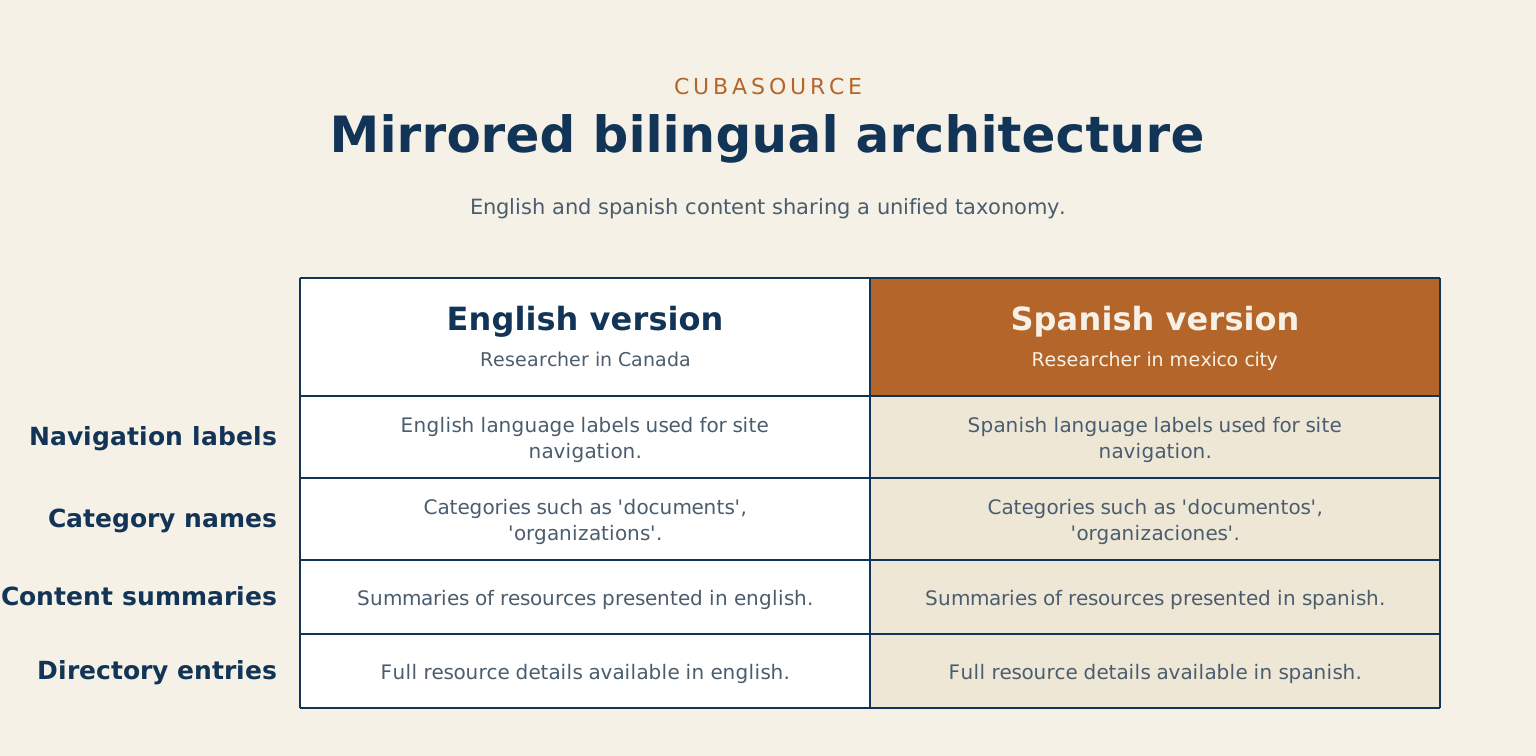
The bilingual requirement ran deeper than the copy. The site was English and Spanish throughout: navigation labels, category names, content summaries, and the directory entries themselves. In 2001, building parallel-language architecture was not a solved problem with an off-the-shelf solution. It required mirrored category hierarchies in both languages, consistent terminology across both, and navigation that made no assumption about which language a user started in. A policy researcher in Mexico City reading a Spanish-language document needed the same navigation path as a Canadian researcher reading the English version. Getting that right meant designing the information architecture bilingually from the start, not translating it afterward.
Low-bandwidth by design
Low-bandwidth optimization was a stated constraint, not an afterthought. The target audience included policy organizations, academic institutions, and journalists in Cuba, Latin America, and the Caribbean: places where broadband internet was neither reliable nor universal in 2001. The design was built for a user on a slow or shared connection, not a researcher at a well-connected North American university. Minimal image footprint, text-first navigation, no JavaScript-dependent interactions on the critical path. Pages had to load and be readable even when the connection was slow, because the most relevant users for a Cuba policy directory were often in the places where that constraint was real.
The content taxonomy
The directory organized resources into four categories: documents, organizations, news, and events. Those four covered the range of material relevant to Cuba policy research. The editorial work of selecting and categorizing resources was FOCAL’s; the technical architecture had to support ongoing additions in both languages without requiring a developer for each new entry. Staff added records through a back-end form; the site rendered them into the correct category tree in English and Spanish automatically. The taxonomy was stable enough to hold for the full life of the site without structural revision.
ASP, Windows/IIS. Wayback Machine captures from mid-2002 show the rebuilt design running continuously through at least 2003. The site title in the 2003 archive: “Cubasource — a Resource of FOCAL’s Research Forum on Cuba.” The FOCAL project entry covers the broader engagement.
- Platform: ASP/Windows/IIS
- Architecture: Bilingual English/Spanish directory, four-category taxonomy, low-bandwidth-first design
- Client: Canadian Foundation for the Americas (FOCAL)
- Period: 2001–2002 (archived through 2003, Wayback Machine confirmed)