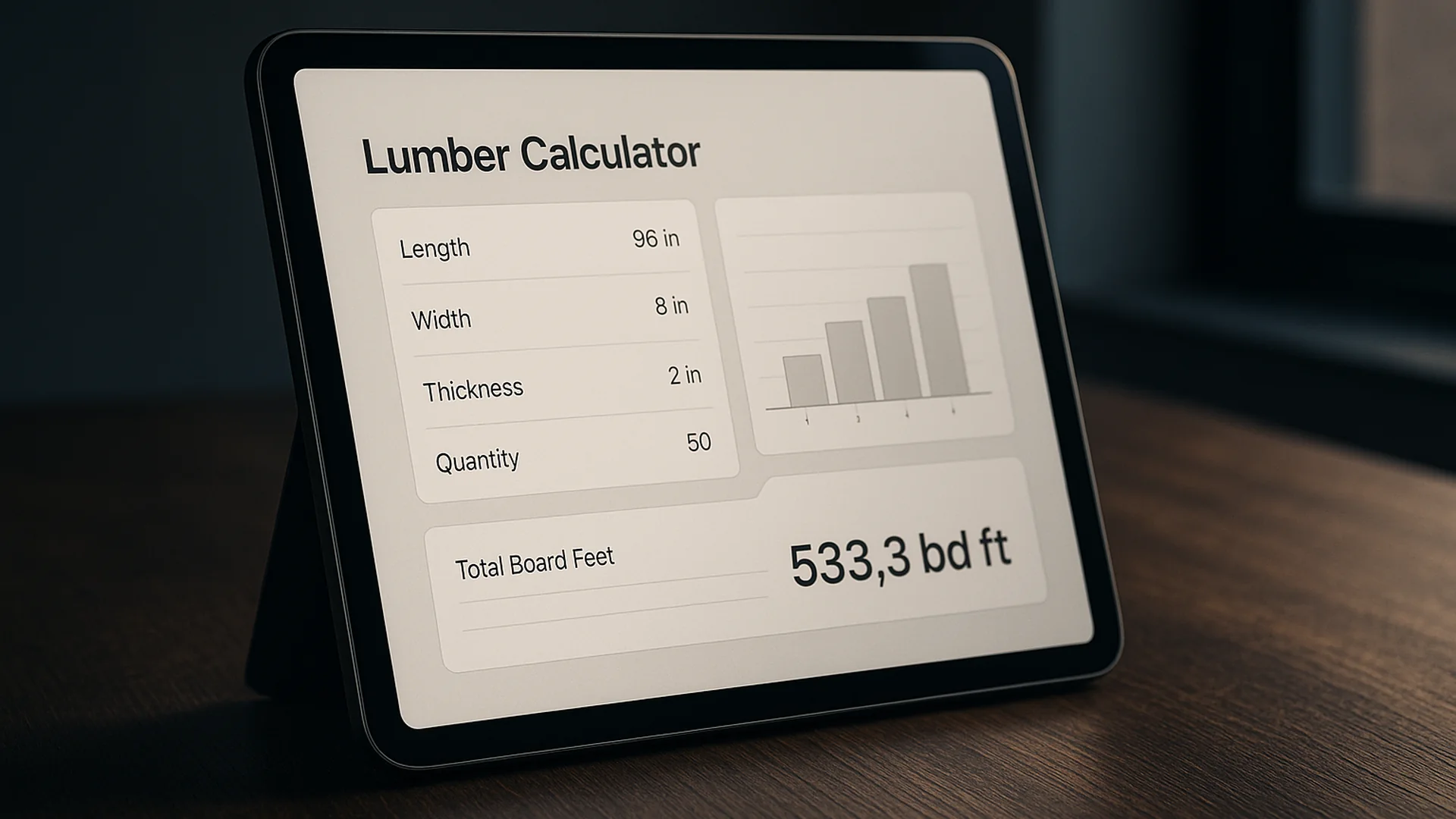
Calculate board feet and optional cost with quantity, unit conversion, and wastage allowances.
How this is calculated
A board foot is a volume measure: 1 inch thick × 12 inches wide × 1 foot long.
board_feet_each = (thickness_in × width_in × length_ft) ÷ 12board_feet_total = board_feet_each × quantity × (1 + wastage%)boards_to_buy = ceil( quantity × (1 + wastage%) )Hardwood is sold by the board foot; dimensional softwood is usually sold by the piece; pick the matching pricing mode.
Use nominal thickness (e.g., 1″ for a "5/4" board); that is what board-foot pricing assumes.
What is a board foot?
A board foot is the volume of a piece of lumber 1″ thick × 12″ wide × 1 ft long, or 144 cubic inches. Hardwood is almost always priced this way. Dimensional softwood (2×4s, 2×6s) is priced per piece.
Should I use nominal or actual lumber dimensions?
Nominal. A "2×4" measures 1.5″ × 3.5″ actual, but board-foot pricing uses 2 × 4. Hardwood is quoted in "quarters" (4/4 = 1″, 5/4 = 1.25″) which are nominal, so use those.
How much wastage for hardwood?
10% covers most rough cuts. Bump to 15–20% when you need clear stock with no defects, when the cut list has lots of short pieces, or when you're working with figured/specialty wood that's more expensive to re-order.
About this lumber calculator
This lumber calculator is designed to turn measurements into practical planning numbers you can use immediately. After entering project dimensions, spacing assumptions, board lengths, waste factors, and optional unit pricing, the calculator processes those values into board count estimates, ordering confidence, and early-stage framing assumptions that reduce avoidable rework. The goal is to replace rough guesswork with a repeatable method that works for homeowner projects, contractor estimates, and field-level decision support. Instead of manually converting units and checking formulas in multiple places, you can complete the process in one workflow.
In day-to-day use, this lumber calculator works best when measurements are taken carefully and entered in one unit system from start to finish. That makes results easier to compare and easier to share with suppliers or team members. It is especially useful for decks, partitions, framing repairs, platform builds, and small structural additions where quick quantity checks can prevent under-ordering, over-ordering, and schedule changes. Using consistent inputs each time also helps standardize estimating habits across repeat jobs.
The most reliable outcomes come from combining calculator output with practical project checks. For this lumber calculator, that means matching board lengths to cut plans and reducing offcut waste before ordering. Treat the result as a planning baseline, then adjust for site conditions, product availability, and project standards before final purchase or scheduling commitments. This approach gives you a safer buffer against costly surprises and keeps conversations with clients, vendors, and crews focused on clear numbers.
Use this lumber calculator as an early planning assistant, not a replacement for final site validation. It helps you test scenarios quickly, compare alternatives, and move from idea to workable estimate with fewer delays. When paired with accurate measurement habits and a final field review, the calculator can improve confidence at every stage: draft budgeting, quote preparation, procurement planning, and pre-install coordination. Revisit it whenever dimensions, material assumptions, or scope details change.
Lumber prices move, and so do customers who cannot get a fast number. A tool like this, on your site, gives them the number on the spot. Book a discovery call
Leave a Reply