The booking went through before I’d finished my coffee. Usually I’m slower than that. I’m a reader, I scroll the reviews, all of them, the four-stars and the angry ones, before I trust a place with a night of my life and a credit card number.
This inn was outside Galena, up a gravel road I’d have driven right past. What stopped me wasn’t the photos, though they were fine. It was the owner. She had answered every single review. Not the easy ones. Every one.
A couple from Iowa had praised the breakfast, and she’d written back, “So glad the rhubarb was ready in time for your stay, John. That patch is finicky.” A man had complained the wifi dropped in the east room, and instead of getting prickly she’d said, “You’re right, that room is our weak spot for signal. We’ve added a booster since your visit. I’d love the chance to put you in the west room next time.” She was calm and specific, no excuses and no fight.
By the time I’d read ten of those I felt like I’d already met her. So I booked. From the other side of the screen, a business that answers its reviews reads as a business that’s paying attention. One that answers none of them reads as a business that closed the laptop in 2019 and walked away. The traveller can’t tell the difference between “too busy to reply” and “gone.” We just see silence.
Most owners don’t skip replies because they don’t care. They skip them because of how the day runs. An innkeeper is up before the guests, cooking the breakfast, turning the rooms, watching the gravel road that needs grading. By the time she sits down, a glowing review feels like it deserves more than a tired “thanks!” and a harsh one makes the throat tighten, because the honest first draft is a defence, and somewhere she knows a defensive reply makes the whole thing worse. So both sit there. The review stays unanswered, and the next traveller reads the silence.
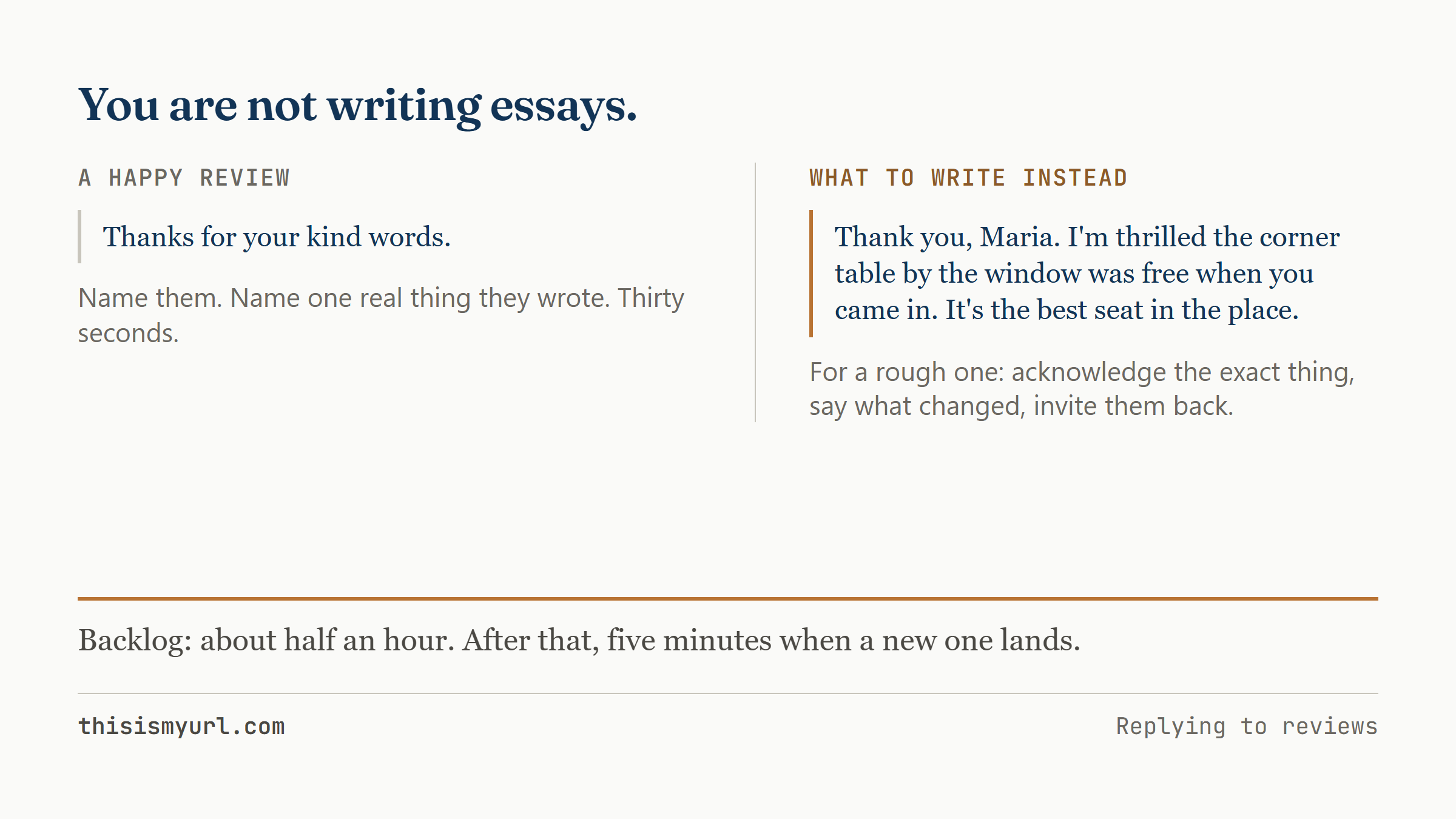
The good news is the fix is mostly about lowering the bar. You are not writing essays.
Go to business.google.com and sign in with the Google account tied to your business. Click your listing, then click Reviews. Start with the most recent and work backward.
For the happy ones, thank the person by name if Google shows it, and name one real thing from what they wrote. Not “Thanks for your kind words.” Try “Thank you, Maria. I’m thrilled the corner table by the window was free when you came in. It’s the best seat in the place.” Thirty seconds. It tells the next reader you were actually there.
For the rough ones, the move is narrow. Acknowledge the exact thing they raised. Don’t argue, don’t explain why they’re wrong even when they are. Say in one breath what’s changed or what you’d do differently, then invite them back. “You’re right that the wait was long that Saturday. We’ve added a second person to weekend mornings since then. Come try us again and ask for me.” Two sentences, maybe three. Resist the long reply. A paragraph defending yourself reads as defensive even when every word is reasonable.
Catching up on a backlog takes about half an hour. After that it’s five minutes when a new one lands, less once you’ve found your rhythm.
You don’t need anyone’s help for this. You don’t need an agency or a monthly fee for this. Just the account you already have and a few minutes with your coffee.
I checked in late on a Thursday. The breakfast the next morning had rhubarb in it, the same finicky patch from John’s review, and when I mentioned I’d read about it she laughed and said most guests never bring up the reviews, they just show up. I told her I’d booked because of them. She seemed surprised that anyone had read that far.