The name was the best thing about it. The Old Mill. Off a two-lane road in farm country, the kind of name that makes you slow down before you’ve decided to stop, because a mill means water and old means stories and you start picturing the place before you’ve even seen it. So I looked it up on my phone, sitting in the car with the engine running, trying to decide whether it was worth the ten-minute detour.
The category said Antique Shop. Good start. Then the description: “Quality products and services since 1987.” That was the whole thing. One line. And I sat there reading it twice, because I genuinely couldn’t tell what they sold. Furniture? Tools? Old signs? Glassware? Was it a place you could lose an hour in, or a place with three dusty shelves? I couldn’t picture the inside. I couldn’t picture anything. So I did the thing I bet a lot of people do at that exact moment. I kept driving.
Here’s what stings about it. That shop has been open since 1987. Somebody has spent thirty-some years learning what’s good, what’s rare, what walks out the door by noon on a Saturday. All of that knowledge, and the one sentence the internet shows a stranger says nothing a stranger can use.
This happens to good businesses constantly, and it’s almost never carelessness. When you set up your Google listing, that little card that pops up when someone searches your name, there’s a box for a description. Most people either leave it blank or type something that sounds like a business ought to sound. “Quality products and excellent service.” It feels safe. It feels professional. The trouble is that it could describe a tire shop or a dentist or a funeral home. It tells the one person reading it nothing about whether to turn the car around.
A description does one job. It helps a stranger decide if you’re worth stopping for. That’s it. And the way you do that job is by being specific, almost uncomfortably specific, in a way that “quality products” never is.
So here’s the fix, and it takes about fifteen minutes.
Go to business.google.com on your phone or computer and sign in with your Google account. Find your business. Click Edit profile, and look for the field marked Description.
Now write two or three sentences. Not more. Say what you actually sell or make. Say the thing that makes you worth the detour. And if you’re only open part of the year, say that too, because nothing wastes a traveller’s afternoon like driving to a closed door.
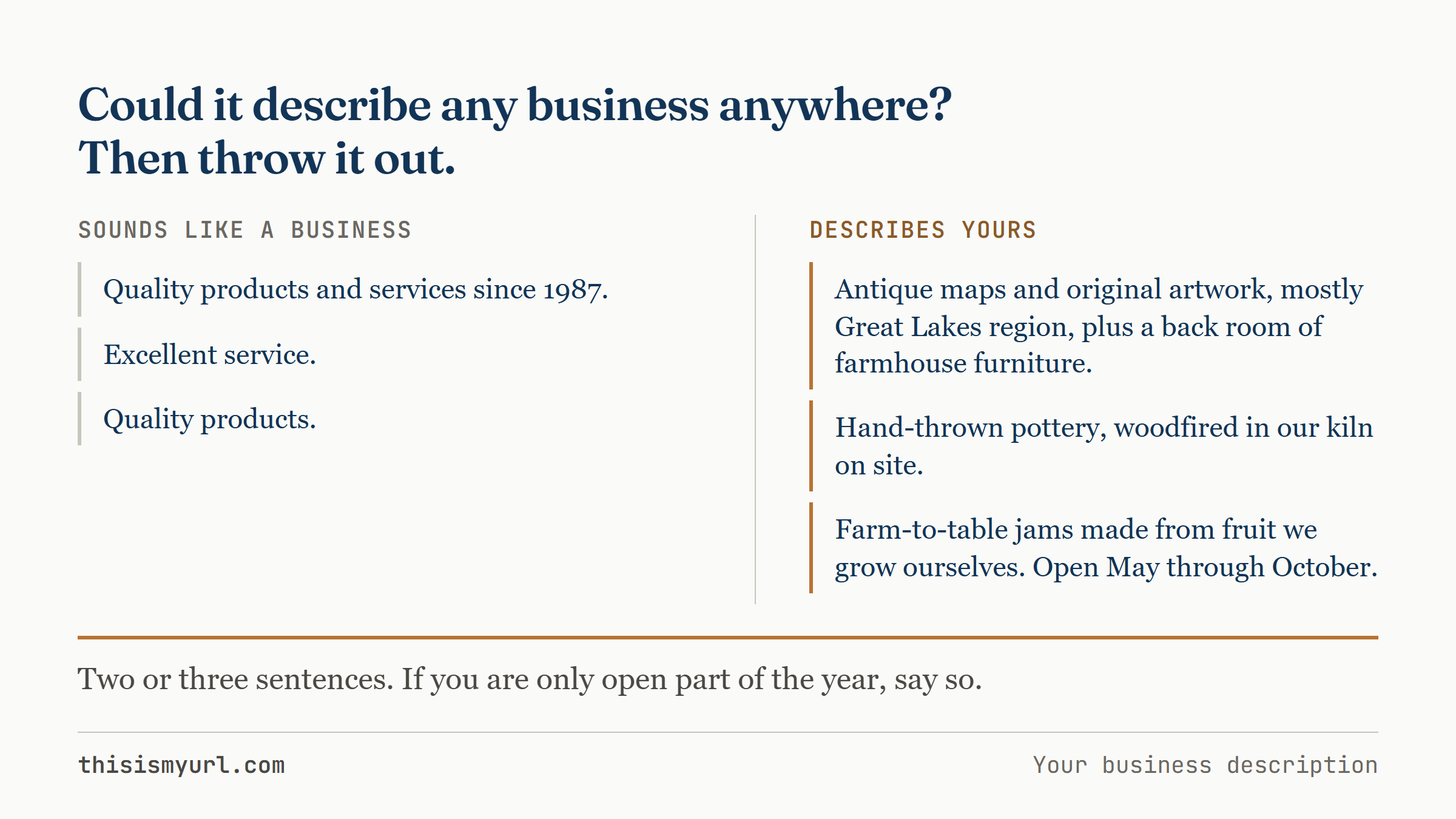
The test for every sentence is this: could it describe any business anywhere? If yes, throw it out. “Excellent service” goes in the bin. “Quality products” goes with it.
Here’s the difference. Bad: “Quality products and services since 1987.” Good: “Antique maps and original artwork, mostly Great Lakes region, plus a back room of farmhouse furniture.” Now I know exactly what I’m walking into. A potter might write: “Hand-thrown pottery, woodfired in our kiln on site.” A farm stand: “Farm-to-table jams made from fruit we grow ourselves. Open May through October.” Read those and you can see the place. You can almost smell it. You know in two seconds whether to pull over.
That’s the whole trick. Trade the words that sound like a business for the words that describe yours. The maps. The kiln. The fruit you grew. The thing you’d tell me if I walked in and asked what you do.
I never did see the inside of The Old Mill. For all I know it’s the best antique shop in three counties, with a corner of railroad lanterns and a wall of old maps somebody would drive an hour to dig through. The name still does its quiet work on the side of that road, slowing people down, making them reach for their phones.