A business daily lives by the clock more than most newsrooms. The Toronto Stock Exchange opens at 9:30 Eastern. Earnings drop after the bell at 4:00. The Bank of Canada’s announcement comes at 10:00 on the dates everyone has marked in the calendar months in advance. None of those moments is curatable by hand. The publishing system has to absorb the traffic spike that arrives on a schedule a homepage editor cannot smooth out, and the article template has to render a quote table or a price chart in the same render pass as the analysis built around it. The platform that carried this was WordPress® VIP, inside Postmedia’s network migration.
FP and the National Post, co-located in Toronto
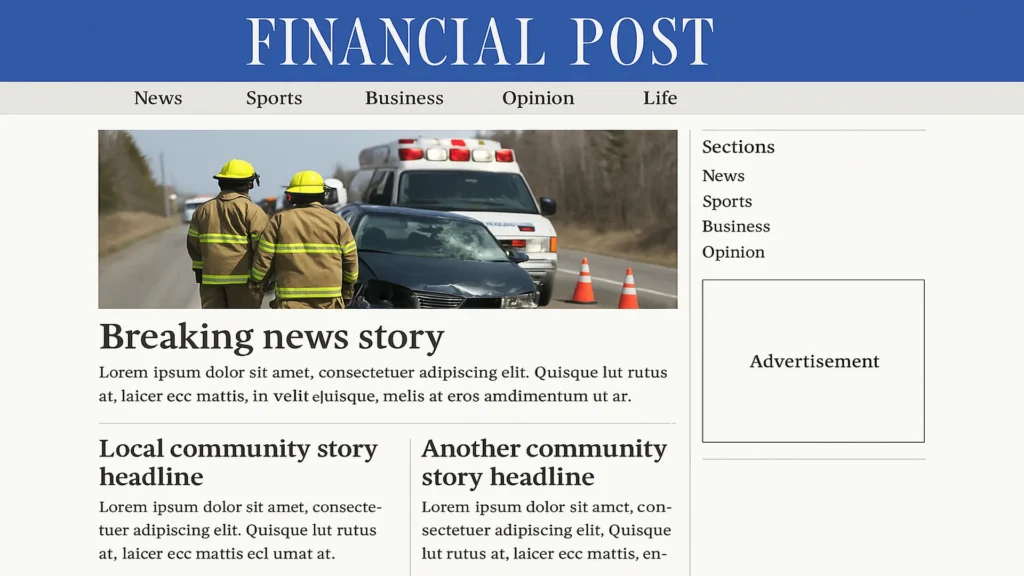
The Financial Post traces its modern form to its 1998 integration into the National Post as the business section that ran with its own masthead. By the time the 2011-2012 Postmedia WordPress migration arrived, FP shared the National Post building in Toronto and a meaningful share of its editorial workflow. The two properties shared the upstream parent theme on the new platform, and FP ran as its own child — same parent code, distinct business-daily templates for quote tables, market-data layouts, sector-specific landing pages, and the long-form analysis pieces that sit next to fast-turn earnings reactions in a single day’s publishing schedule.
The parent handled performance budget, cache strategy, and infrastructure consistency across the network. The FP child handled the editorial shape of business journalism — the patterns that do not appear on a regional civic paper. Quote-table markup that survives both responsive layouts and screen-reader narration. Market-snapshot panels that update without re-flowing the article. Sector landing pages where the reader’s mental model is “I want everything on energy this week” rather than “I want today’s news from Calgary.” Each pattern earned its own template treatment in the FP child without forking the codebase.
Restraint as the operative design discipline
The lesson FP work taught most clearly is one I still bring to every financial publisher engagement. Tables, charts, and pull-quotes all want to be the loudest element on the page. Each of them is, in isolation, a legitimate emphasis tool. Put three of them on a single article and the reader cannot tell what the journalist is actually arguing. Restraint in spacing, type scale, ad-slot placement, and inline data treatment is what keeps the reader on the analysis instead of bouncing through the chrome. The article template that looks plain when there is only prose is the one that holds up when the prose carries a chart, a quote, and an embedded earnings snapshot in the same scroll length.
The Postmedia VIP migration was the engagement where this discipline got fully codified. The early WordPress VIP onboarding process required a full codebase review from Automattic’s enterprise team before the first deploy, which meant the templates that shipped had to be defensible to senior engineers outside the immediate project team. Defensible templates are restrained templates. The reader of a business daily benefits from that posture in a way that does not always show up in the analytics.
- The work: Business-daily template engineering on the FP child theme inside the Postmedia WordPress VIP migration
- Architecture: Shared parent with the National Post and the rest of the Postmedia network; FP-specific child
- Client: Postmedia Network Inc. (Financial Post brand)
- Period: 2011-2012
Any financial publisher engagement I take on now starts with this discipline: the article template that looks plain when there is only prose is the one that holds up when the data lands beside it.
Product names referenced on this page — including WordPress — are trademarks or registered trademarks of their respective owners. Training offered here is independent and is not affiliated with, endorsed by, or sponsored by any of these companies.