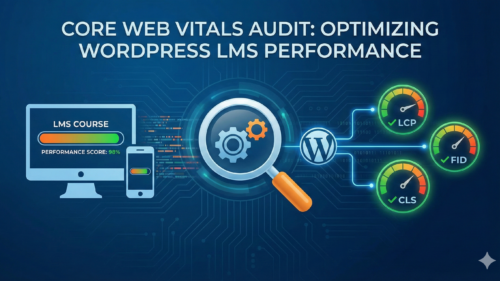
Core Web Vitals Audit: Optimizing WordPress LMS Performance
A Core Web Vitals audit for WordPress LMS involves measuring LCP (loading), CLS (stability), and INP (responsiveness). Critical…
Cognitive Friction is a psychological term used in UX design to describe the mental effort required by a user to process information or complete a task on a website. When a site is poorly organized, over-optimized with robotic text, or cluttered with intrusive pop-ups, the user’s brain has to work harder just to understand the value proposition. This “mental drag” creates a negative emotional response, leading to frustration, distrust, and eventually, the user leaving the site in favor of a competitor who offers a clearer path.
For high-end marketing, minimizing cognitive friction is the secret to high conversion rates. We achieve this through “Search Experience Optimization” (SXO)—using intuitive navigation, clear headings, and authentic brand language that speaks like a human, not a machine. If your service page uses linguistic gymnastics to repeat keywords, you are creating friction. A professional Niagara agency builds “frictionless” journeys where the user feels guided and supported, allowing them to reach a decision point (like booking a consultation) without mental exhaustion.
In the era of AI-driven search, Google rewards sites that minimize friction because they result in higher “Dwell Time” and “Satisfaction Signals.” By removing the “Digital Baggage” and complex “Jigsaw Puzzles” of layout, you create a seamless immersion. Your website should feel like a well-lit, organized physical storefront where the product is easy to find and the staff is easy to talk to. Reducing friction isn’t just a design choice; it is a strategic revenue-driver.
A Core Web Vitals audit for WordPress LMS involves measuring LCP (loading), CLS (stability), and INP (responsiveness). Critical…

Scale your Enterprise WordPress Infrastructure with our white paper on server-level tuning. From kernel logic to Decoupled Architecture,…

Video is no longer a luxury—it is the primary driver of search engine visibility and customer trust in…

In the race for "green scores," many businesses accidentally engineer themselves out of the market. Over optimization is…