For the last decade, the chattering classes of Silicon Valley and the high-priced consultants of the L&D world have been predicting the “Death of the LMS.” They claimed that the Learning Management System was a relic—a digital filing cabinet where SCORM files went to die and where employees spent forty minutes of their lives they’d never get back, clicking “Next” to satisfy a compliance officer.
They were wrong.
Table of Contents
The Digital Ivory Tower: State of the LMS Union
The LMS didn’t die; it underwent a radical, high-stakes metamorphosis. In 2026, LMS Environments are no longer just administrative repositories; they are the central nervous systems of the modern enterprise. We have moved from the “Registration Era” to the “Performance Era.” If you are still treating your platform as a passive library, you aren’t just behind the curve—you’re essentially trying to run a high-frequency trading desk on a Commodore 64.
The Myth of the “Plug-and-Play” Ecosystem
The industry-standard myth that plagues C-suite discussions is that an LMS is a “product” you buy off a shelf. In reality, modern LMS Environments are sophisticated digital ecosystems that require the same level of architectural rigor as your CRM or ERP. To the uninitiated, choosing between a legacy giant, a customized moodle instance, or a lean wordpress-based stack seems like a matter of UI preference. To the expert, it is a foundational decision regarding data sovereignty, API extensibility, and the “half-life” of your organization’s collective knowledge.
The nuance that beginners miss is the shift from content delivery to context delivery. A sophisticated environment doesn’t just ask, “Did the user complete the course?” It asks, “How did the user’s behaviour change in the CRM after they interacted with this learning object?” We are no longer building ivory towers to store wisdom; we are building the plumbing that delivers that wisdom directly into the “flow of work”—the exact moment a salesperson is losing a lead or a developer is staring at a broken deployment script.
The $70 Billion Stakes
With the global market valuation for learning tech crossing the $70 billion mark, the stakes for getting your environment right have never been higher. We are seeing a “Great Bifurcation” in the market. On one side, you have the open-source stalwarts like Moodle, which offer a degree of modularity that would make a LEGO enthusiast weep with joy. On the other, the agility of the WordPress ecosystem allows marketing-savvy organizations to treat their training like a high-conversion sales funnel.
Choosing between these is not a technical task; it is a strategic one. Your choice of environment dictates whether your human capital is an appreciating asset or a depreciating liability.
The Architect’s Quick-Scan: State of the Union
- The Myth: The LMS is a compliance-driven cost centre.
- The Reality: High-performing LMS Environments are performance engines that correlate learning data with business KPIs.
- The Pivot: We are moving away from “Time-Spent-Learning” as a metric toward “Skill-Application-Velocity.”
- The Tech Split: Moodle: The choice for those requiring deep governance and academic-grade pedagogical tools. WordPress: The choice for rapid deployment, commercialized learning, and “marketing-first” engagement strategies.
Monoliths vs. LXPs: Choosing Your Structural Integrity
In the architectural world, there is a fundamental tension between the Cathedral and the Bazaar. The Cathedral is a singular, grand, and highly controlled environment—think the classic, monolithic LMS Environments like Blackboard or SAP SuccessFactors. The Bazaar, by contrast, is a riot of decentralized discovery, a chaotic but vibrant marketplace—the Learning Experience Platform (LXP).
For the modern CTO, the choice between these two isn’t just about software; it’s about organizational philosophy. If you build a Cathedral, you are betting on top-down governance. If you build a Bazaar, you are betting on the “wisdom of the crowd.”
The Monolith’s Last Stand
The traditional LMS is often maligned as “clunky,” but this criticism ignores its primary architectural purpose: The Single Source of Truth. In highly regulated industries—aerospace, pharmaceuticals, or finance—the “Bazaar” approach is a liability. You don’t want your nuclear plant operators “crowdsourcing” their safety protocols from a trending YouTube video.
Monolithic LMS Environments excel at structured learning paths. They provide a rigid, audited framework where an admin can guarantee that Learner A saw Version 2.0 of Document B at exactly 09:00 UTC. It is the architecture of certainty. However, the technical debt of these systems is often their undoing; their APIs are frequently an afterthought, making integrations with modern tools feel like performing open-heart surgery with a butter knife.
The LXP: Netflix for Learning?
Enter the LXP—the industry’s response to “learner apathy.” While an LMS tells you what you must know, an LXP suggests what you might like. Technically, LXPs function as a discovery layer. They sit atop various content repositories—pulling from LinkedIn Learning, internal wikis, and even the occasional moodle instance—to create a unified, AI-driven interface.
The “secret sauce” of the LXP is its use of machine learning algorithms to personalize the dashboard. It treats the learner not as a student to be managed, but as a consumer to be won over. But here is the nuance most beginners miss: An LXP is not an LMS. It lacks the robust tracking, compliance reporting, and administrative “teeth” required for formal certification. If you try to run a global compliance program solely on an LXP, you will eventually find yourself in a deposition explaining why your data is “directional” rather than “definitive.”
The Hybrid “Headless” Strategy
The most sophisticated enterprises have stopped choosing. They are moving toward a “Headless” LMS environment. In this model, the LMS acts as the robust, secure “engine room” (the back end), while the LXP or a custom-built wordpress front end acts as the “cockpit” (the UI). This allows for the high-end engagement of a consumer app without sacrificing the cold, hard data integrity required by the legal department.
Structural Integrity Check: Cathedral vs. Bazaar
- The Monolith (LMS): Essential for compliance, certification, and top-down curricula. High control, lower engagement.
- The Bazaar (LXP): Ideal for skill-building, social learning, and employee-led growth. High engagement, lower auditability.
- The Expert Move: Use the LMS as your Record of Authority and the LXP as your Engagement Layer.
- The Technical Risk: “Integration Fatigue.” Every layer you add increases the latency of your data syncing—ensure your SSO (Single Sign-On) is bulletproof before attempting a hybrid stack.
The Moodle Manifesto: Open-Source Governance in an Academic World
In the glossy brochures of high-end SaaS vendors, moodle is often treated like the “ugly duckling” of LMS Environments. It is perceived as the academic workhorse—reliable, free-to-play, but perhaps a bit too much like a 1990s Linux distribution for the tastes of a sleek corporate HR department.
This perception is a massive strategic oversight.
To the industry expert, Moodle is the “Linux of Learning.” It is an open-source powerhouse that offers a level of pedagogical granularity that proprietary systems simply cannot match. While other platforms give you a “walled garden,” Moodle gives you the soil, the seeds, and a backhoe, then asks if you’d like to build an irrigation system from scratch.
The Power of the Modular Architecture
Technically, Moodle’s strength lies in its modular PHP-based architecture. It isn’t a singular application; it is a collection of over 2,000 plugins revolving around a core engine. For an organization with a strong DevOps team, this means you can rewrite the very DNA of how your environment handles enrollment, authentication, or grading.
As we enter 2026, the release of Moodle 5.1 has pushed this even further with a revamped AI Subsystem. Unlike SaaS competitors that lock you into a single proprietary LLM, Moodle allows you to plug in your own local AI providers. This is a game-changer for “Sovereign Learning”—organizations that want the benefits of AI-generated content or tutoring without their proprietary data being sucked into a public training model.
Moodle Workplace: The Enterprise Pivot
For a long time, Moodle’s biggest flaw in a corporate context was its lack of Multi-Tenancy. Large conglomerates needed “Tenants”—individual silos for different departments or subsidiaries that shared the same core code but kept their data separate.
Enter Moodle Workplace. This is the enterprise-grade skin on the classic engine, specifically designed to handle “Extended Enterprise” scenarios. It allows an admin to manage thousands of users across disparate business units while maintaining a unified reporting line. It takes the academic flexibility of the core platform and wraps it in a governance layer that speaks the language of the C-suite: compliance, automation, and organizational hierarchies.
Hardening the Environment: Beyond the Default
The “Accidental Admin” often fails because they treat Moodle as a “set-and-forget” installation. A high-stakes Moodle environment requires hardening. This means moving past the default settings to implement:
- Redis Caching: To prevent the database from choking during a Monday morning “compliance rush.”
- PHP 8.2+ Optimization: Leveraging the latest JIT (Just-In-Time) compilation for faster page delivery.
- Object Storage (S3): To handle the terabytes of video content without bloating the local server’s SSD.
If your Moodle instance is slow, it’s rarely the software’s fault; it’s usually because the infrastructure is gasping for air.
The Expert’s Moodle Audit
- The Sovereignty Play: You own the code. If your vendor goes bankrupt, your school stays open.
- The AI Advantage: Use the Moodle AI Subsystem to integrate “Private LLMs”—essential for IP-heavy industries.
- The Multi-Tenancy Fix: If you are a global enterprise, don’t use “Standard” Moodle; you need the Workplace edition for tenant isolation.
- The Performance Hack: Never run Moodle on shared hosting. Minimum 16GB RAM and a dedicated Redis instance for session management are non-negotiable for 1,000+ concurrent users.
The WordPress Pivot: When Marketing Becomes the Classroom
or a certain segment of the industry, the term “LMS” conjures images of grey enterprise portals and mandatory HR training. But there is a parallel universe where LMS Environments are built not for compliance, but for conversion. In this world, the classroom is a sales funnel, and the student is a high-value customer.
This is the domain of the wordpress-based LMS. If Moodle is the “Linux of Learning,” then WordPress is its “Pop-up Shop.” It is the preferred stack for the “Expert Economy”—consultants, influencers, and boutique training firms who need their learning platform to look as slick as a high-end marketing site and convert like a SaaS landing page.
The “Plugin-First” Architecture
Unlike monolithic systems, a WordPress LMS is an exercise in compositional architecture. You start with the world’s most popular CMS and layer on specialized engines like LearnDash or LifterLMS.
Technically, these plugins don’t just add “courses”; they extend the WordPress database schema to include new custom post types: Lessons, Topics, Assignments, and Quizzes. This allows you to leverage the entire WordPress ecosystem—SEO tools like RankMath, page builders like Elementor, and e-commerce heavyweights like WooCommerce—to build a learning environment that is indistinguishable from a premium consumer experience.
Beware the “Franken-stack”
The greatest strength of the WordPress approach is also its fatal flaw: The Franken-stack. Because it is so easy to add functionality, many organizations fall into the trap of “Shiny Object Syndrome.” They stitch together a patchwork of thirty different plugins—one for the video player, one for the gamification, one for the PDF certificates, and another for the “Dark Mode” toggle.
In 2026, a “Franken-stack” is a high-stakes liability. Every additional plugin increases your attack surface and introduces dependency hell. When WordPress core updates, or when your hosting provider moves to PHP 8.4, a poorly coded plugin from a solo developer in 2021 can bring your entire $500k-a-year training business to a grinding halt. The expert knows that a high-performance WordPress LMS isn’t about how many plugins you add, but how many you can eliminate through custom hooks and efficient coding.
The Commercial Edge: SEO and Monetization
Why endure the maintenance overhead of WordPress? Because of its unmatched SEO (Search Engine Optimization) capabilities. If your goal is to attract learners via organic search, Moodle is a ghost town. WordPress, however, allows you to wrap your learning content in a sophisticated content marketing engine.
By using “Speculative Loading” and modern formats like AVIF for media, a well-optimized WordPress LMS can achieve “Core Web Vitals” scores that make enterprise monoliths look like they’re running on dial-up. In the high-stakes world of commercialized learning, a 2-second delay in page load isn’t just a nuisance—it’s a 20% drop in your conversion rate.
The Expert’s WordPress Blueprint
- The Use Case: Ideal for B2C course sales, internal “marketing-style” onboarding, and high-conversion “expert” platforms.
- The Core Tech: Stick to the “Big Three” (LearnDash, LifterLMS, or TutorLMS). Don’t experiment with unproven, “lite” plugins for core functionality.
- The Performance Secret: Use Object Caching (Redis/Memcached) and a CDN. WordPress is database-heavy; without object caching, your server will choke as soon as 50 students try to take a quiz simultaneously.
- The Security Rule: Implement Activity Logs and WAFs (Web Application Firewalls). In a WordPress environment, “Who changed this setting?” is the most common question you’ll need to answer during a crisis.
Interoperability or Incarceration? The LTI 1.3 Standard
If you’ve ever tried to force two pieces of enterprise software to talk to each other without a standard protocol, you know it feels less like “integration” and more like a hostage negotiation. Historically, LMS Environments were notorious for being “walled gardens”—digital fortresses designed to keep your data in and your competitors out.
The industry’s answer to this digital incarceration is LTI 1.3 (Learning Tools Interoperability). If your LMS is the house, LTI 1.3 is the universal power outlet that ensures any appliance—be it a sophisticated AI proctoring tool, a virtual lab, or a third-party content library—plugs in and works instantly.
The Security Renaissance: Moving Past OAuth 1.0
The common industry myth is that “any LTI version will do.” This is a dangerous misconception. Legacy versions (LTI 1.1 and 1.2) relied on OAuth 1.0a, a security model that is effectively the technical equivalent of leaving your front door key under the mat.
LTI 1.3 changed the game by adopting the 1EdTech Security Framework, which utilizes OAuth2, OpenID Connect (OIDC), and JSON Web Tokens (JWT). This isn’t just “tech-speak” for a better password; it’s a fundamental shift in how trust is established between systems. In an LTI 1.3 environment, the LMS and the external tool exchange cryptographically signed messages, ensuring that learner data (PII) is never exposed to man-in-the-middle attacks. If you are still running LTI 1.1, you aren’t just out of date—you’re a liability waiting for a data breach to happen.
LTI Advantage: The Triple Threat
The real magic of the modern standard isn’t just the security; it’s the LTI Advantage suite—three specific services that turn a simple link into a deep, two-way integration:
- Deep Linking: Gone are the days of sending a student to a generic “Tool Homepage” and hoping they find the right assignment. Deep Linking allows instructors to browse an external tool (like a Pearson library or a YouTube playlist) directly from their moodle or wordpress dashboard and pull in specific resources as native-looking course objects.
- Names and Role Provisioning (NRPS): This is the “Roster Engine.” In older systems, an external tool didn’t know a student existed until they clicked the link. With NRPS, the tool can securely pull the entire class list, allowing instructors to see who hasn’t started the assignment yet—a critical data point for early intervention.
- Assignment and Grade Services (AGS): This is the holy grail of L&D. It enables sophisticated, automated grade passback. It doesn’t just send a “score”; it can send the status (started/in-progress), time spent, and even instructor comments back to the central gradebook, keeping your “Single Source of Truth” actually truthful.
The “Sovereignty” Play
For the savvy CTO, LTI 1.3 is the ultimate hedge against vendor lock-in. By ensuring your LMS Environments are LTI Advantage certified, you retain the power to swap out components of your “stack” without re-writing a single line of integration code. You can move your content from a legacy monolith to a sleek wordpress front-end and, provided both support the standard, your external simulations and gradebooks won’t skip a beat.
Data Beyond the “Completed” Button: xAPI and Caliper
If you are still measuring the success of your LMS Environments by “Completion Rates,” you are effectively measuring the success of a library by how many people walked through the front door. It tells you nothing about whether they actually read the books, let alone if they applied the knowledge to solve a problem.
The industry is currently obsessed with “Vanity Metrics,” but the high-stakes reality of 2026 demands Behavioral Intelligence. This is where the duo of xAPI (Experience API) and Caliper Analytics comes into play. They are the tools that finally allow us to stop asking, “Did they finish?” and start asking, “What did they actually do?”
The Anatomy of an Experience: Actor-Verb-Object
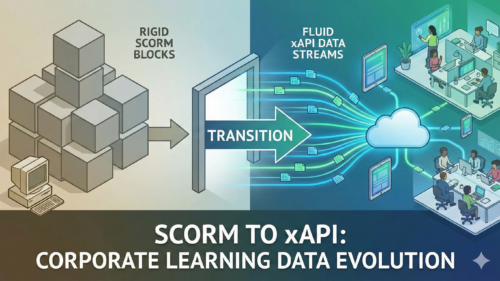
Technically, xAPI (formerly known as Tin Can) moves us away from the restrictive packaging of SCORM. Instead of a monolithic zip file that only talks to the LMS, xAPI uses a simple, elegant JSON-based statement structure: Actor, Verb, Object.
In a modern environment, this looks like: “Janice (Actor) ‘resolved’ (Verb) ‘the Javascript Debugging Simulation’ (Object).” This statement doesn’t have to live inside your moodle instance. It can be triggered by a code commit on GitHub, a specific interaction in a VR headset, or even a localized event in a wordpress sales plugin.
The LRS: Your Data’s Engine Room
For these statements to mean anything, you need a Learning Record Store (LRS). A common rookie mistake is trying to force the LMS to act as the primary database for xAPI data. This is like trying to use a toaster to cook a seven-course meal; it’s not built for that level of transactional throughput.
A dedicated LRS (like Learning Locker or Watershed) sits outside your LMS, acting as a high-speed repository that can aggregate data from dozens of “Activity Providers.” This allows you to correlate learning data with actual business performance. When you can see that employees who spent 15 minutes in the “Negotiation Sim” also closed 20% more deals in Salesforce, you have moved from L&D as a “cost centre” to L&D as a “revenue driver.”
Caliper: The Metric Profile Powerhouse
While xAPI is the “wild west”—allowing you to define almost any verb—Caliper Analytics (from 1EdTech) is its more disciplined, structured sibling. Caliper uses “Metric Profiles” to standardize how data is collected for specific types of activities, such as reading an e-book or taking a high-stakes assessment. For institutional environments or large-scale academic setups, Caliper provides a level of data consistency that makes cross-platform comparative analytics actually possible.
The Data Architect’s Cheat Sheet
- The Shift: Move from “Course Completion” (SCORM) to “Activity Streams” (xAPI).
- The LRS Rule: Never store granular xAPI data in your LMS database. It will bloat your tables and kill your performance. Use a dedicated LRS.
- The Integration: Use xAPI to track “Learning in the Flow of Work.” Trigger statements from Slack, Jira, or your CRM to see where learning actually happens.
- Caliper vs. xAPI: Use xAPI for creative, non-traditional tracking; use Caliper for standardized, rigorous institutional reporting.
The Rise of the AI Agent: From Chatbots to Cyber-Tutors
For the past two years, the integration of Artificial Intelligence into LMS Environments has been characterized by what we might call the “Chatbot Window Dressing” phase. You likely saw a generic, hallucination-prone window in the corner of your screen that could summarize a PDF but couldn’t tell you the difference between your company’s 2024 travel policy and a recipe for sourdough bread.
In 2026, we have moved into the Agentic Era. We are no longer talking about passive tools that wait for a prompt; we are talking about autonomous AI Agents that perceive, reason, and act within the learning ecosystem. These agents don’t just answer questions—they proctor exams, coach struggling learners, and dynamically rewrite curriculum on the fly.
RAG: Grounding the “Hallucinating” Mentor
The technical breakthrough that made this possible is Rethieval-Augmented Generation (RAG). Traditional Large Language Models (LLMs) are “closed-book” systems—they only know what they were trained on. RAG transforms your LMS into an “open-book” system by connecting the AI to your proprietary internal knowledge base (your PDFs, videos, and wikis) in real time.
When a learner asks, “How do I submit a patent at this company?” the RAG-enabled agent doesn’t guess based on the internet. It retrieves the specific, encrypted document from your moodle or wordpress database, “reads” it, and provides a grounded, cited answer. This eliminates the risk of hallucinations and ensures that your IP remains secure within your environment’s perimeter.
From Static Pathways to Agentic Coaching
The “smart-fun” reality of agentic learning is that the course itself becomes a living entity. Instead of a linear path (Module A – Module B), the agent monitors learner behaviour using the xAPI data we discussed in Section 6.
If the agent detects a “struggle pattern”—for example, a learner spending 10 minutes on a 2-minute quiz question—it doesn’t wait for them to fail. It intervenes. It might offer a “just-in-time” micro-video, suggest a peer-mentor who recently mastered that topic, or even adjust the difficulty of the next module to prevent “learning fatigue.”
The “Sovereign AI” Strategy
For the enterprise expert, the nuance here is Sovereignty. High-stakes organizations are moving away from public LLM wrappers. They are hosting “Small Language Models” (SLMs) locally or in private clouds. By integrating these via the Moodle AI Subsystem or custom WordPress hooks, you get the cognitive power of an agent without sending a single byte of learner data to a third-party server. This is the only way to satisfy a 2026-era compliance audit.
Multi-Tenancy: Building Skyscrapers in the Cloud
In the early days of EdTech, if a global conglomerate wanted to provide unique training environments for its 50 different subsidiaries, the solution was as elegant as a sledgehammer: you simply installed 50 separate copies of the software. This led to “Administrative Purgatory”—a nightmare of 50 different security patches, 50 different database migrations, and a consolidated reporting process that required a small army of data scientists and a lot of prayer.
Modern LMS Environments solve this through Multi-Tenancy. Think of it like a high-end apartment building. Every tenant has their own key, their own furniture, and their own private balcony, but they all share the same structural foundation, plumbing, and electrical grid.
Shared-Schema vs. Isolated-Database
From a technical standpoint, how you “partition” your skyscraper matters. There are two primary architectural paths:
- Shared-Schema (Soft Tenancy): All tenants live in the same database table, separated only by a
tenant_idcolumn. It’s fast and cost-effective, but if a developer writes a “lazy” query, Tenant A might accidentally see Tenant B’s sensitive HR data. - Isolated-Database (Hard Tenancy): Each tenant gets their own physical database, but they share the same application code. This is the “Gold Standard” for high-stakes environments. It offers maximum security and allows for specialized data residency (e.g., keeping your German subsidiary’s data on a server in Frankfurt to satisfy GDPR, while the US data sits in Virginia).
The “Extended Enterprise” Gambit
The most sophisticated use of multi-tenancy today isn’t just for internal departments; it’s for the Extended Enterprise. This is where you turn your LMS from a cost centre into a revenue-generating machine by “selling” training environments to your partners, franchisees, or customers.
Using a platform like Moodle Workplace, you can create a “Master Tenant” that pushes global compliance courses down to all subsidiaries, while allowing each “Child Tenant” to upload their own local content and brand their interface with their own logos and colors. To the end-user, it looks like a bespoke, boutique learning portal. To the global admin, it’s a single dashboard where they can see the entire organization’s “Skill Heatmap” in real-time.
The WordPress Multi-Site Alternative
For those leveraging a wordpress stack, multi-tenancy is achieved via WordPress Multisite (WPMS). While powerful, it requires a “disciplined architect.” Because plugins are shared across the network, a single update to a core learning plugin can ripple across every sub-site. The expert knows that in a WPMS environment, you don’t “live-test” updates; you use a staged “blue-green” deployment to ensure that a CSS tweak for the “Sales Team” doesn’t accidentally break the “Engineering Team’s” final exam.
The Security Perimeter: Defending the “Learning Vault”
If you think your LMS Environments are just for storing quizzes and “How-To” videos, you are catastrophically misjudging the landscape. To a modern cyber-adversary, your LMS is a high-value target known as a “Data Hive.” It contains Personally Identifiable Information (PII), proprietary corporate IP, and, perhaps most dangerously, a map of your organization’s skill gaps—information a competitor would pay handsomely to exploit.
Defending this perimeter requires moving beyond the “set it and forget it” mentality. In 2026, a breach doesn’t just result in a leaked spreadsheet; it can lead to a total loss of institutional trust and a multi-million dollar GDPR fine.
The Vulnerability of the Open Stack
While we’ve praised the flexibility of moodle and wordpress, their openness is their primary attack vector. Because they rely on extensive plugin ecosystems, they are only as secure as the weakest line of code in a third-party add-on.
Technically, we are concerned with Cross-Site Scripting (XSS) and SQL Injection. In a sophisticated LMS environment, an attacker might inject malicious code into a “Discussion Forum” post. When an Admin views that post, the script executes, stealing the Admin’s session cookie and granting the attacker total control over the “Learning Vault.”
To mitigate this, the expert implements Content Security Policies (CSP) and strictly enforces Principle of Least Privilege (PoLP)—ensuring that a “Teacher” role has zero access to the underlying server configuration or database schema.
Hardening the Pipeline: WAFs and Zero Trust
The “Smart-Fun” way to look at LMS security is to treat it like a high-security casino. Everyone is welcome, but everyone is watched.
High-stakes environments leverage a Web Application Firewall (WAF) like Cloudflare or Sucuri. These tools act as a “bouncer,” scrubbing incoming traffic for known attack patterns before they ever reach your WordPress or Moodle core.
Furthermore, the industry is moving toward Zero Trust Architecture (ZTA). In this model, the system assumes that every user—even the CEO—is a potential threat. Every request is verified, authenticated, and authorized. If a user typically logs in from London at 9:00 AM but suddenly attempts a bulk export of “Employee Performance Data” from an unrecognized IP in Eastern Europe at midnight, the environment should automatically trigger a “kill-switch” and lock the account.
Encryption: Resting vs. In-Transit
Most beginners ensure their site has an SSL certificate (HTTPS), which secures data in-transit. But the nuance is protecting data at-rest. Your database should be encrypted. If an intruder manages to bypass your firewall and walk away with a copy of your SQL database, they should find nothing but a useless wall of scrambled ciphertext.
Learning in the Flow of Work: The Invisible LMS
The greatest paradox of modern corporate training is that the more “engaging” you make your LMS, the more you risk distracting your employees from the very work they are supposed to be doing. We are currently facing a “Context-Switching Tax”—the cognitive drain that occurs every time a developer has to leave their IDE or a salesperson has to leave Salesforce to hunt for a tutorial in a separate moodle instance.
The industry’s elite architects are moving toward the Invisible LMS. The goal is no longer to drive traffic to a destination; it is to deliver the “Learning Object” directly into the Flow of Work.
The “Headless” LMS: Decoupling UI from Logic
Technically, this shift is powered by Headless Architecture. In this model, the LMS Environments act strictly as a back-end engine via a robust REST API. The “Head” (the user interface) is wherever the employee already lives.
If you are using a wordpress stack, this might involve using the WordPress REST API to push learning notifications directly into a custom-built Chrome extension. If your team lives in Slack or Microsoft Teams, your “Invisible LMS” uses webhooks to deliver a 30-second micro-learning “nugget” the moment a specific keyword is mentioned in a project channel. You aren’t “going to training”; the training is coming to you, exactly when your “Time Poverty” is highest and your need for answers is greatest.
EPSS: The Performance Support Revolution
We are seeing the return of the Electronic Performance Support System (EPSS), but reimagined for the AI age. Instead of a 40-minute course on “How to Close a Deal,” the environment provides a “Just-in-Time” overlay on top of the CRM.
This requires a high degree of Deep Linking and LTI 1.3 sophistication (as discussed in Section 5). By leveraging Object Metadata, the LMS knows exactly which piece of content solves a specific technical snag. For example, if a junior engineer triggers a specific error code in a terminal, the “Invisible LMS” detects the event and immediately serves a “hotfix” video in a pop-up window. This isn’t education in the classical sense; it is Augmented Intelligence.
The Analytics of the Invisible
The challenge for the “Invisible” model is tracking. If the learner never “logs in” to the LMS, how do you prove they learned anything? This is where xAPI (Section 6) becomes the hero of the story. Because the “Invisible LMS” sends “Actor-Verb-Object” statements from the flow of work (e.g., “Developer A ‘watched’ ‘Security Patch Tutorial’ inside VS Code”), the LRS captures the data without the user ever seeing a “Submit” button.
The “Time Poverty” Crisis: Designing for the 1%
According to recent industry benchmarks, the average modern professional can only dedicate about 1% of their work week to formal learning. That’s roughly 24 minutes. If your LMS Environments are designed around hour-long seat times and “comprehensive” modules, you aren’t just wasting time; you are fighting a losing battle against biological limits.
We have reached the era of Time Poverty Architecture. To succeed, your environment must transition from being a “Knowledge Buffet” to a “Surgical Strike” delivery system.
Micro-Learning: The Atomic Unit of Retention
Technically, this requires a shift from monolithic course files to Atomic Learning Objects. Instead of one large SCORM package, you decompose your curriculum into discrete, searchable “nuggets.”
The “Smart-Fun” reality is that your LMS needs to behave more like TikTok and less like a university library. This means your wordpress or moodle environment must support:
- Variable Bitrate Streaming: Ensuring a video starts instantly on a mobile device in an elevator.
- Progress Persistence: If a learner has 45 seconds between meetings, they should be able to watch half a video and have their exact timestamp saved across all devices.
- Push-Notification Logic: Using spaced-repetition algorithms to send a “Knowledge Pulse” (a single-question quiz) via mobile notification 24 hours after a lesson is completed.
Mobile-First vs. Mobile-Responsive
A common industry myth is that “responsive design” is enough. It isn’t. A responsive site just shrinks the desktop experience. A Mobile-First environment recognizes that the thumb is the primary navigation tool.
In a high-stakes WordPress LMS, this means utilizing PWA (Progressive Web App) technology. PWAs allow your learning environment to be “installed” on an employee’s phone without the friction of an App Store download. It allows for offline caching—so a technician can access a critical “How-To” manual while in a basement with zero bars of service—and then syncs the xAPI data back to the LRS once they return to a 5G zone.
The Logic of “Spaced Repetition”
To combat the “Forgetting Curve,” top-tier LMS Environments are now integrating automated Spaced Repetition Systems (SRS). Instead of a one-and-done final exam, the system uses a “Leitner System” backend to re-introduce difficult concepts at increasing intervals. If the learner gets a concept right, they see it in a week; if they get it wrong, they see it again tomorrow. This isn’t just “training”; it’s the technical engineering of long-term memory.
The Time-Poverty Defence Strategy
- The 90-Second Rule: No single learning object should exceed 90 seconds. If it does, break it into a “Thread.”
- PWA over Apps: Use Progressive Web Apps to bypass App Store friction and provide offline access.
- The Search Priority: Ensure your LMS has “Deep Search” capabilities. An employee shouldn’t have to click through three levels of a “Category Tree” to find a single PDF.
- Spaced Repetition: Implement automated “Knowledge Pulses” to transform one-time learning into permanent skill sets.
Conclusion: The Post-LMS Horizon
The paradox of the modern LMS Environments is that the more successful they become, the more they disappear. We are rapidly approaching a “Post-LMS” reality where the platform itself is no longer the star of the show; it is the silent, high-performance engine powering a much larger Skills Ecosystem.
As we look toward the 2026 horizon, the “Smart-Fun” takeaway for the industry expert is that we are moving from Information Consumption to Capability Validation. The ivory towers are being dismantled and replaced by a decentralized network where your learning doesn’t live in a company database—it lives with you.
The Rise of the Sovereign Learner
Technically, this shift is underpinned by Blockchain-verified Micro-credentials. In the old world, if you left your job, your training records stayed behind in the corporate Moodle instance. In the new world, your achievements are issued as tamper-proof, cryptographically signed tokens (using standards like Open Badges 3.0). These live in a digital “Skills Wallet” that you own.
For the enterprise, this is a massive win for Internal Skills Marketplaces. Instead of manually auditing resumes, AI agents can instantly scan the verified blockchain “tags” of the entire workforce to find a developer who understands both Python and high-frequency trading. It turns human capital into a liquid asset that can be deployed with surgical precision.
The “Invisible” Final State
Eventually, the very term “LMS” will likely feel as quaint as “Electronic Mail.” We will simply speak of Performance Infrastructure. Whether that infrastructure is built on a hardened moodle core, a high-conversion wordpress front-end, or a headless API-first monolith, its value will be measured by one thing: Skill-Application-Velocity.
The architects who thrive in this era will be those who stop building repositories and start building pathways. They will recognize that in a world of infinite content and zero time, the most valuable thing an LMS environment can provide is not more “stuff” to learn, but the shortest possible path to mastery.
The 2026 Executive Summary
- The Death of the Box: The LMS is no longer a software package; it is an integrated layer of the corporate operating system.
- Blockchain Sovereignty: Digital wallets will replace the centralized training record, giving employees ownership of their “Skill DNA.”
- The AI Pivot: AI is moving from “Chatbot” to “Agent,” taking over the heavy lifting of curriculum design and personalized proctoring.
- The Bottom Line: If your learning environment doesn’t directly correlate to a business KPI, it’s just a digital hobby. Build for performance, or don’t build at all.