In the mezzanine of the modern enterprise, the Learning Management System (LMS) is frequently the most expensive “black box” on the balance sheet. For decades, Chief Learning Officers have operated under the illusion of digital transformation, while their underlying data remains trapped in the rigid, mid-aughts constraints of legacy interoperability. The choice of a data standard is not a back-office technicality; it is the strategic pivot point between a stagnant cost centre and a high-velocity talent engine.
Table of Contents
The Interoperability Crisis: Why Standards Govern Talent
The primary friction in corporate education is not a lack of content, but the inability of that content to speak to the systems that house it. We find ourselves in an interoperability crisis where “integration” is often a euphemism for fragile, custom-built bridges that collapse under the weight of the first software update. When data cannot move fluidly between platforms, the organization loses its most valuable asset: the ability to correlate learning with actual performance.
“In the modern enterprise, a learning strategy without a data standard is merely a collection of expensive videos. Interoperability is the prerequisite for institutional intelligence.”
This crisis is compounded by the shift toward “Learning in the Flow of Work.” As education moves out of the classroom and into Slack, Teams, and specialized CRM environments, the old borders of the LMS are dissolving. Organizations that fail to adopt an API-First HR Tech mindset are essentially flying blind, relying on completion percentages as a proxy for competence—a metric as useful as counting the hours a pilot spends in a flight simulator without checking if they can actually land the plane.
A Tale of Two Architectures: The Cost of Inertia
To understand the stakes of this architectural choice, consider two hypothetical logistics giants navigating a sudden shift in global supply chain regulations.
- Company A (The Legacy Loyalist): Relies on a monolithic LMS and SCORM 1.2. They deploy a mandatory 45-minute module. They spend $4M on content and administration. Their dashboard shows 98% completion. Six months later, they suffer a major compliance failure in their EMEA division because the “Click-Next” modules failed to identify that their veteran managers didn’t actually understand the new customs logic.
- Company B (The Ecosystem Architect): Utilizes a Federated Learning Record Store (LRS) and xAPI. They track not just the training, but real-time customs filing errors in their ERP. Their system identifies a specific knowledge gap in “Tariff Classification” within the first 48 hours. They deploy targeted micro-learning only to the affected teams. Total spend: $2M. Compliance failure: Avoided.
Company A spent $4M on a module that no one remembered; Company B spent $2M on a behavioral tracking ecosystem that identified a leadership vacuum before it became a turnover crisis.
SCORM: The Resilient Ghost in the Machine
SCORM (Sharable Content Object Reference Model) is the COBOL of the HR department: antiquated, frustratingly rigid, and yet, somehow, the thread that holds the entire tapestry together. Born from a 1999 Department of Defence initiative, SCORM was designed for a world of desktop computers and physical local area networks. It solved the “Plug and Play” problem of the era, ensuring that a package from Content Provider A would launch and report a score in LMS Provider B.
Despite its age, SCORM remains the industry baseline. This is largely due to the “sunk cost” of legacy content libraries and the relative simplicity of its reporting. If your primary objective is to verify that an employee sat through a 20-minute compliance module, SCORM is perfectly adequate.
| Feature | SCORM 1.2 | SCORM 2004 (4th Ed.) |
|---|---|---|
| Release Year | 2001 | 2009 |
| Data Limit | 4,096 characters (Suspend Data) | 64,000 characters |
| Sequencing | None (Linear only) | Complex branching logic |
| Status Tracking | Binary (Pass/Fail) | Granular (Incomplete/Completed) |
| Primary Use Case | Basic compliance | Interactive desktop modules |
However, SCORM’s resilience is also its greatest weakness. It relies on a persistent browser connection and a “Handshake” that is notoriously prone to failure on mobile devices. Its data model is inherently $N=1$; it tracks one learner, in one course, in one session.
The LMS Sandbox and Its Limitations
The SCORM environment is a sandbox—safe, contained, and entirely disconnected from the real world. From a Technical SEO and Data Science perspective, this represents a massive loss of “Information Gain.” In the sandbox, we measure time spent rather than value created.
Consider the learning efficacy formula:
Where $E$ is Efficacy, $v$ is the volume of behavioral data points, $g$ is the granularity of those points, and $C$ is the cost of delivery. In a SCORM environment, $g$ is essentially a constant of 1. You know when they started and finished. You do not know if they struggled with a specific slide or if they revisited the material after a month.
SCORM is a tool for auditing, not for insight. It satisfies the legal department but leaves the strategy department starving for actionable intelligence.
xAPI: Beyond the “Click-Next” Binary
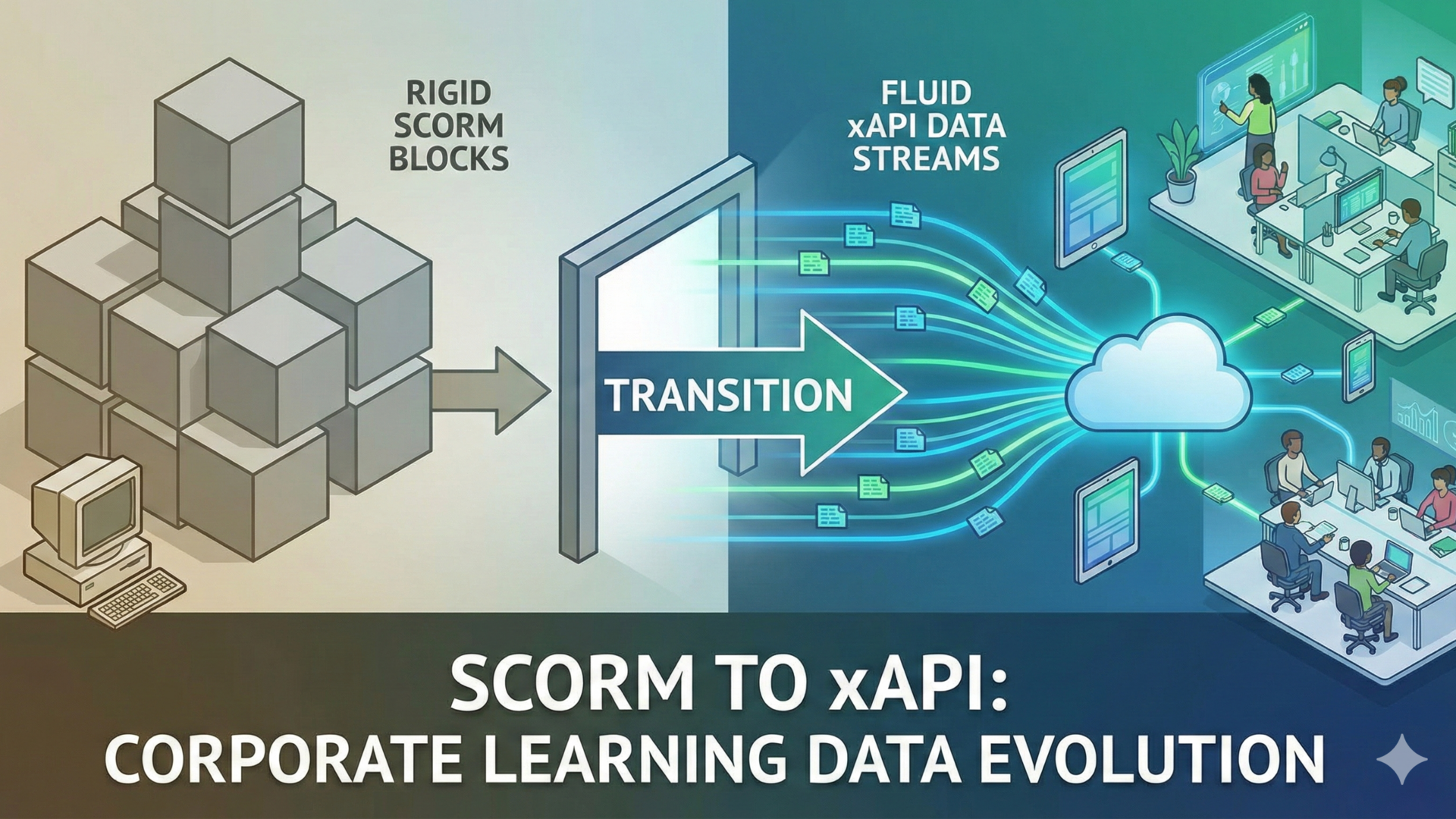
If SCORM is a photograph of a student in a classroom, xAPI (the Experience API) is a 4K video stream of that student in the field. It treats learning as an ecosystem, not a destination. It uses a semantic “Statement” structure based on a JSON-formatted Actor-Verb-Object framework.
- “John Smith (Actor) Completed (Verb) Safety Training (Object).”
- “Jane Doe (Actor) Read (Verb) The Q3 Strategy Paper (Object).”
- “Michael Chen (Actor) Mentored (Verb) Sarah Jenkins (Object) on Python Optimization.”
The AI Substrate: Why LLMs Demand xAPI
As organizations pivot toward Agentic Workflows, the data standard becomes the critical substrate. Generative AI is only as effective as the context it consumes. SCORM’s binary “Pass/Fail” is useless for an AI coach trying to understand why an employee is struggling.
Conversely, xAPI statements provide the longitudinal behavioral data needed for Retrieval-Augmented Generation (RAG) systems to offer hyper-personalized remedial training. An AI agent can ingest thousands of xAPI statements to recognize that a developer’s code reviews consistently flag “Security Vulnerabilities,” allowing the AI to proactively surface targeted encryption modules before the developer even realizes they have a gap.
xAPI is the fuel for the corporate “digital brain.” Without it, your AI initiatives are merely expensive chat interfaces sitting on top of an empty data lake.
cmi5: The “Goldilocks” Solution
Many organizations hesitate to adopt xAPI because it lacks the “packaging” rules that make SCORM easy for an LMS to ingest. This is where cmi5 enters the fray. It provides the structure that pure xAPI lacks, defining how content is launched and how a session is managed.
“If SCORM is a physical book and xAPI is a collection of random pages, cmi5 is the library system that ensures every page is in its correct place and easily searchable.”
For the enterprise architect, cmi5 is the most prudent path forward; it allows you to maintain the organizational control of an LMS while leveraging the analytical depth of a modern API.
Architecting the Ecosystem: The LRS Transition
Migrating to a modern model requires a change in data architecture. The centerpiece is the Federated Learning Record Store (LRS). Unlike an LMS, which manages people and content, an LRS manages statements.
The Learning Analytics Maturity Model:
- Descriptive (SCORM): “What did they finish?” (Rearview mirror).
- Diagnostic (xAPI): “Why did they fail the simulation?” (Under the hood).
- Predictive (LRS Integration): “Who is likely to fail in the field based on simulator behaviour?” (Lookahead).
- Prescriptive (AI-Powered): “What specific task should this employee do next to maximize ROI?” (Automation).
Transitioning to an LRS-centric architecture is not a “replacement” of the LMS, but an augmentation. It moves the centre of gravity from administration to insight.
Advanced Financial Modeling: The “Skills Half-Life”
Resistance to modernization is usually financial. However, in a world where technical skills expire every 2.5 years, the cost of stagnant data is astronomical. We must calculate the Economic Depreciation of Knowledge (EDK) to understand the true cost of legacy standards.
Where $V$ is the initial value of the skill, and $\lambda$ is the decay constant of that skill in the current market.
Without xAPI, $\lambda$ is an unknown variable. The organization continues to pay for skills that have already depreciated to zero. By adopting a granular standard, firms can move toward Precision Learning, reducing “Over-Training” by up to 30%. When the system can detect that a user already possesses a skill through their Slack interactions or GitHub commits, it can bypass unnecessary modules.
The ROI of modern data standards is found in the reduction of “waste” (unnecessary training) and the acceleration of “readiness” (time to competency).
Final Verdict: Future-Proofing the Learning Stack
The era of the monolithic LMS as a record-of-truth is ending. The future of corporate education is a distributed, data-rich ecosystem where learning is indistinguishable from work. Choosing the right standard is not about the technology of today; it is about the questions you want to be able to answer five years from now.
If you want to know if your training actually moved the needle on quarterly revenue, or if your talent pool is prepared for the next technological pivot, SCORM cannot help you. The competitive advantage lies with those who embrace the granularity of the Experience API.
Determining the correct path for your specific infrastructure requires a technical audit of your existing data gravity. Whether you are navigating a migration from a legacy LMS or architecting a new LRS-centric ecosystem, my consultancy provides the technical granularity and strategic oversight required to turn your learning data into a competitive asset. Contact me to begin your architectural transition.
Advanced FAQ: Tactical Insights for Professionals
How does cmi5 handle session state differently than SCORM’s “Suspend Data”?
cmi5 utilizes a defined ‘State API’ within the xAPI specification. Unlike SCORM 1.2, which often hit a 4,096-character limit (causing data loss in complex courses), cmi5 allows for virtually unlimited state storage. More importantly, cmi5 manages “Return URL” and “Fetch URL” protocols, allowing for a much more robust “Resume” function across different devices and browsers without the connection errors common in legacy systems.
Can an LRS truly replace an LMS for compliance auditing?
Technically, yes, but strategically, no. An LRS is designed for data storage and retrieval, not for user management, course catalogs, or enrollment workflows. For compliance, the LRS serves as the “Proof of Record,” but you still require a management layer (either a modern LMS or a Learning Experience Platform – LXP) to handle the administrative business logic.
What is the impact of xAPI on Data Privacy and GDPR compliance?
xAPI statements can be highly granular, often including PII (Personally Identifiable Information). Professionals must implement “Personas” within their LRS to map multiple identifiers (email, OpenID, employee ID) to a single user. Under GDPR, the “Right to be Forgotten” becomes more complex in a federated LRS environment, requiring strict data governance and purging protocols.
Is there a performance overhead when switching from SCORM to xAPI?
In terms of network latency, xAPI is significantly more efficient. SCORM relies on frequent, synchronous JavaScript calls that can hang a browser. xAPI uses asynchronous RESTful calls. However, there is a “Data Science overhead”—the volume of data generated by xAPI is magnitudes higher than SCORM. Organizations must be prepared for the storage and processing requirements of millions of statements per month.
How do “Verbs” in xAPI avoid semantic drift across different departments?
Semantic drift is mitigated through the use of Verb Recipes and the ADL Vocabulary Registry. Professionals should reference established IRIs (Internationalized Resource Identifiers). For example, using the standard ADL verb for “Completed” ensures that regardless of the tool used, the action remains a universally understood data point within the LRS.