Sherwin-Williams’s industrial wood-coatings business reaches its market through a distributor network, which means a distributor’s product knowledge is the actual sales channel. If the person behind the counter can’t talk through a finish schedule, recommend the right sealer for a white-oak vanity, or troubleshoot a colour reader that’s drifted, the sale walks. Channel staff competence is the product. That reframes what a training platform has to do — it isn’t a content library, it’s the qualification layer underneath the entire distribution model.
I designed and built the M.L. Campbell Distributor Training Centre to carry that weight, and I run it day to day for the distributor network across North America. The foundation is WordPress and LearnDash with extensive custom development concentrated in the places off-the-shelf LearnDash makes assumptions that don’t hold for a channel-distributor audience — enrollment, dashboard layout, and the reporting surface branch managers actually need.
Organised by role, not by content type
The course catalogue is structured around the jobs distributor staff actually do. Level 1 Wood Coating Specialist is where a new hire starts. From there a learner branches into Colour Specialist, full-line M.L. Campbell Product Specialist, or equipment-specific tracks like DataColor Reader Pro Specialist. A new employee at a distributor knows what their job is on day one. They don’t yet know which fifty lessons match it. The dashboard does that mapping for them — courses surface by track, status flags show what’s enrolled and what’s complete, and a single “Continue Study” button drops them back exactly where they left off.
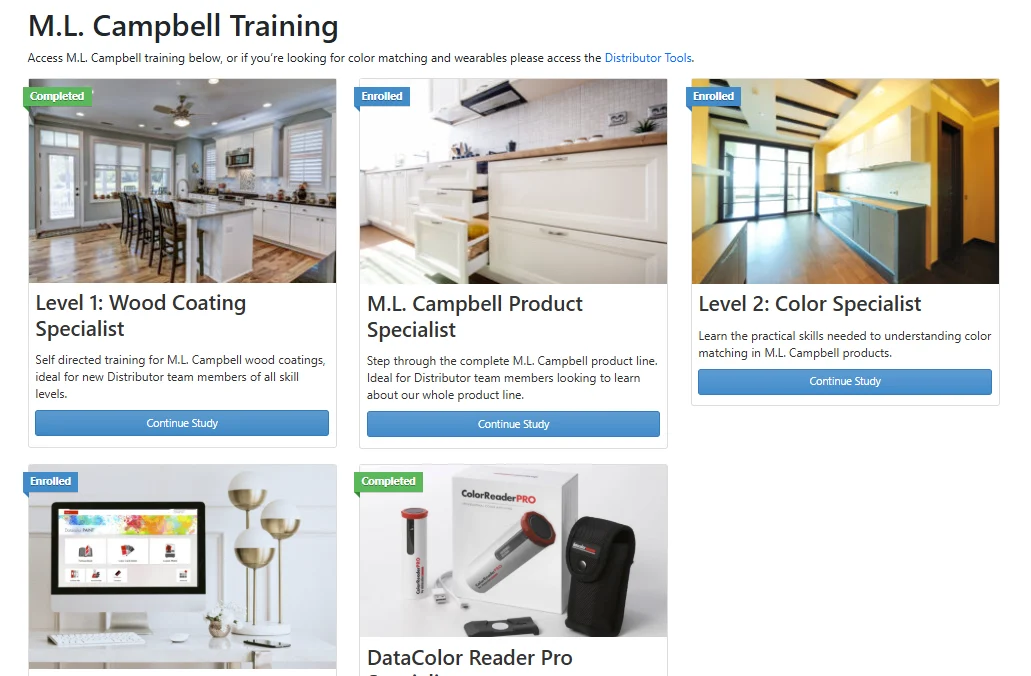
Lessons built for the way distributor staff actually study
Each lesson runs instructor-led video in a picture-in-picture frame over the slide content the instructor is walking through. Breadcrumbs keep the learner oriented inside the track — Level 1, Introduction, a Brief History of M.L. Campbell — and a status pill marks the lesson complete the moment the criteria are met. Completion is preserved per learner per lesson, which sounds obvious until you watch how distributor staff actually train. They study in ten- and twenty-minute windows between customer calls and deliveries, not in ninety-minute blocks. The “Continue Study” pattern is doing real work there. Lose the resume state and you lose the learner.
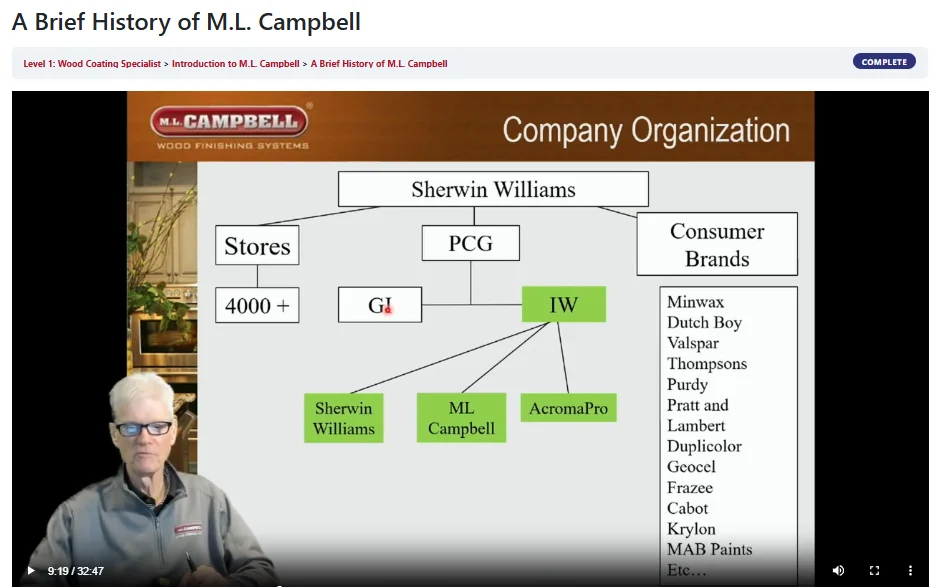
State is the artifact, not the video
The platform’s job isn’t to host video. Its job is to be the system of record for who is qualified to do what across the distributor network. Which staff at which branch hold which certifications. Who’s mid-track on Colour Specialist. Who finished Level 1 last quarter and hasn’t moved since. The lessons are the surface; the completion data is the asset. Designing it that way meant treating learner state, role-based access, and certification status as the primary data model and letting the content layer hang off that — not the other way around.
What it produced
The platform replaced an earlier, more expensive third-party system. It delivered at a fraction of that platform’s cost, and active learner attendance grew by an order of magnitude over the life of the engagement. That growth isn’t a marketing number. In a channel-distributor context it’s a channel-health number — each completed Level 1 Wood Coating Specialist certification is a distributor employee who can now have a real conversation with a finisher evaluating a topcoat. The training platform sits one step upstream of revenue, and the completion record is what makes that visible to the people staffing the network.
Where this pattern transfers
This pattern fits any organisation where staff competence is load-bearing and distributed across locations the head office doesn’t directly control. Channel sales networks. Regulated trades. Franchise operations. Manufacturer rep groups. The shape is always the same — role-based tracks, short-session lesson architecture, and a completion record that means something to someone other than the learner. The MLC engagement is also where I sharpened a habit I bring to every senior LMS build now: design the data model around qualification state first, then let the content surface hang off it. That ordering is what separates a training site from a qualification system, and it’s the lesson that goes straight into every higher-rate edu and gov build I take on.
Product names referenced on this page — including WordPress — are trademarks or registered trademarks of their respective owners. Training offered here is independent and is not affiliated with, endorsed by, or sponsored by any of these companies.